
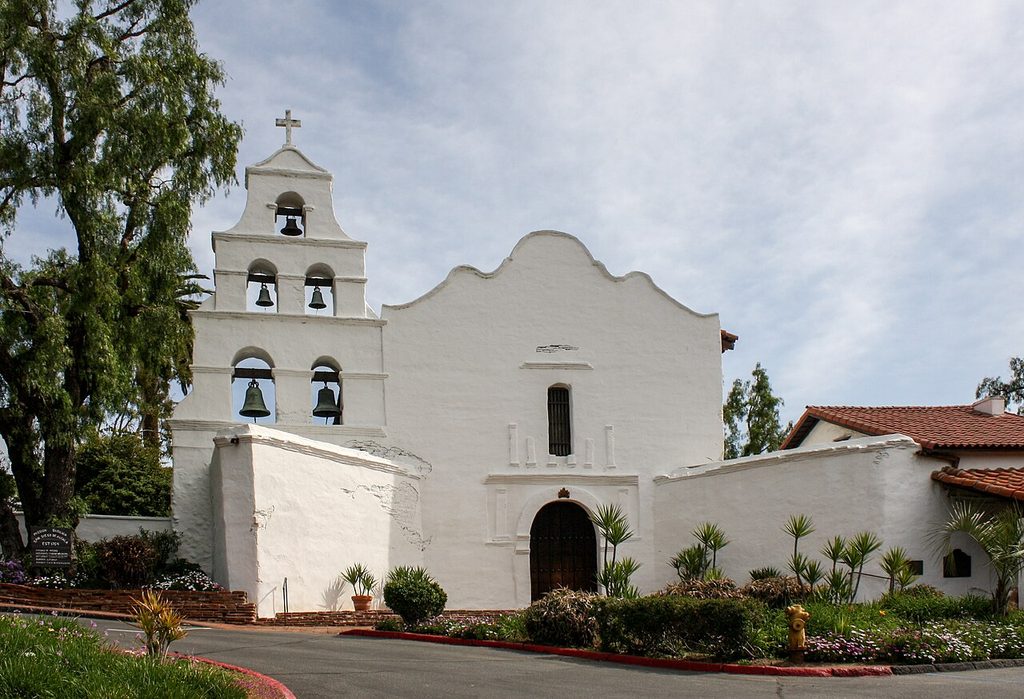
Mission San Diego de Alcalá stands in Mission Valley, about six miles inland from San Diego Bay, as the oldest of California’s 21 Spanish missions. Founded in 1769, it marks the southern starting point of El Camino Real, the “Royal Road” that eventually linked the mission chain north to Sonoma. Its thick adobe walls, river-fed water system, and valley setting show how early builders adapted to the region’s semi-arid climate long before mechanical cooling existed.
Founding on Presidio Hill in 1769
Father Junípero Serra, a Franciscan friar, founded the mission on July 16, 1769, on a hill overlooking the San Diego River. The mission shared that hilltop with a presidio, a Spanish military fort built to secure Spain’s claim to Alta California. The early settlement struggled almost immediately. Supply ships arrived late, crops failed in the dry soil, and relations with the Kumeyaay, the Indigenous people who had lived in the region for thousands of years, grew strained.
These hardships pushed the padres toward a major decision within just five years.
The Move to Mission Valley in 1774
In 1774, the padres relocated the mission about six miles upriver, near the Kumeyaay village of Nipaguay. The new site offered several practical advantages:
- A more dependable water supply from the San Diego River
- Richer valley soil for crops such as wheat, corn, and barley
- Distance from presidio soldiers, whose conduct had damaged relations with local Kumeyaay communities
The move, however, did not resolve the deeper conflict that Spanish colonization created. On the night of November 4, 1775, several hundred Kumeyaay attacked and burned the new mission. Father Luis Jayme died in the attack, and the Catholic Church later recognized him as California’s first Christian martyr.
Adobe Construction and Climate Adaptation
After the fire, builders turned to adobe, a sun-dried brick made from clay, sand, water, and straw. Kumeyaay laborers performed much of the construction, and the current church, completed in 1813, is the fifth to stand on the site. Its walls reach several feet thick. That mass does far more than hold up the roof.
How Thermal Mass Works
Thermal mass describes a material’s ability to absorb, store, and slowly release heat. Thick adobe soaks up heat during warm afternoons and releases it after sunset, so interior temperatures stay steadier than outdoor conditions. The U.S. Department of Energy identifies thermal mass as a core element of passive solar design, the practice of using a building’s materials and layout, rather than equipment, to manage heat.
Why the Approach Suits San Diego
San Diego has a semi-arid Mediterranean climate, with mild, wet winters and long, dry summers. The coast receives only about 10 inches of rain in a typical year, according to National Weather Service climate data. Mission Valley also sits beyond much of the cooling influence of the coastal marine layer, the low cloud deck that rolls in from the Pacific, so it often runs warmer than beach neighborhoods on summer afternoons. Wide day-to-night temperature swings and autumn Santa Ana winds, the hot, dry gusts that blow from the inland deserts toward the coast, make adobe’s slow heat transfer especially useful.
Water Engineering and the Old Mission Dam
Limited rainfall made irrigation essential to mission agriculture. In the early 1800s, Kumeyaay laborers under mission direction built a stone dam across the San Diego River roughly five miles northeast of the church. The structure measured about 220 feet long and 12 feet high, and a tile-lined channel carried water down to the mission fields.
Engineers and historians regard the Old Mission Dam as one of the first major irrigation projects on the Pacific Coast. It became a National Historic Landmark in 1963, and its remains still stand inside Mission Trails Regional Park. The dam illustrates a challenge that still shapes life in San Diego County: securing water in a region that rarely provides enough on its own.

Secularization, Military Use, and Restoration
The mission’s fortunes shifted sharply after Mexico won independence from Spain. The following milestones trace its decline and recovery:
- 1834: Governor José Figueroa ordered secularization, transferring mission lands from church to civil control.
- 1846 to 1862: The U.S. Army occupied the grounds and used the buildings as barracks.
- 1862: President Abraham Lincoln signed a proclamation returning the mission to the Catholic Church.
- 1931: Large-scale restoration resumed, reviving the church’s early 19th-century appearance.
- 1970: The federal government designated the mission a National Historic Landmark.
- 1976: Pope Paul VI named the church a minor basilica.
Preservation work on structures like this follows its own rules. The California Historical Building Code gives qualified historic buildings flexibility to meet safety and performance goals without destroying original materials. The California Office of Historic Preservation oversees many of the state programs that support this work.
The Mission’s Influence on San Diego Today
Mission San Diego de Alcalá still operates as an active parish and museum in the heart of Mission Valley. Visitors can see the campanario, a freestanding bell wall that has become one of the site’s defining features, along with gardens and archaeological remains. The mission also remains an important place for understanding Kumeyaay history, including the forced labor and cultural disruption the mission system imposed.
The mission’s design legacy reaches well beyond its walls. Spanish Colonial Revival architecture, popularized in San Diego after the 1915 Panama-California Exposition in Balboa Park, borrowed its thick stucco walls, clay tile roofs, and deep-set windows.
Thousands of older homes in neighborhoods such as Mission Hills, Kensington, and North Park reflect that influence. Many predate central air conditioning, so owners often pair original shading and heat-control features with modern home cooling systems. When inland heat waves push that equipment hard, AC repair in San Diego becomes a seasonal concern for households across the region.